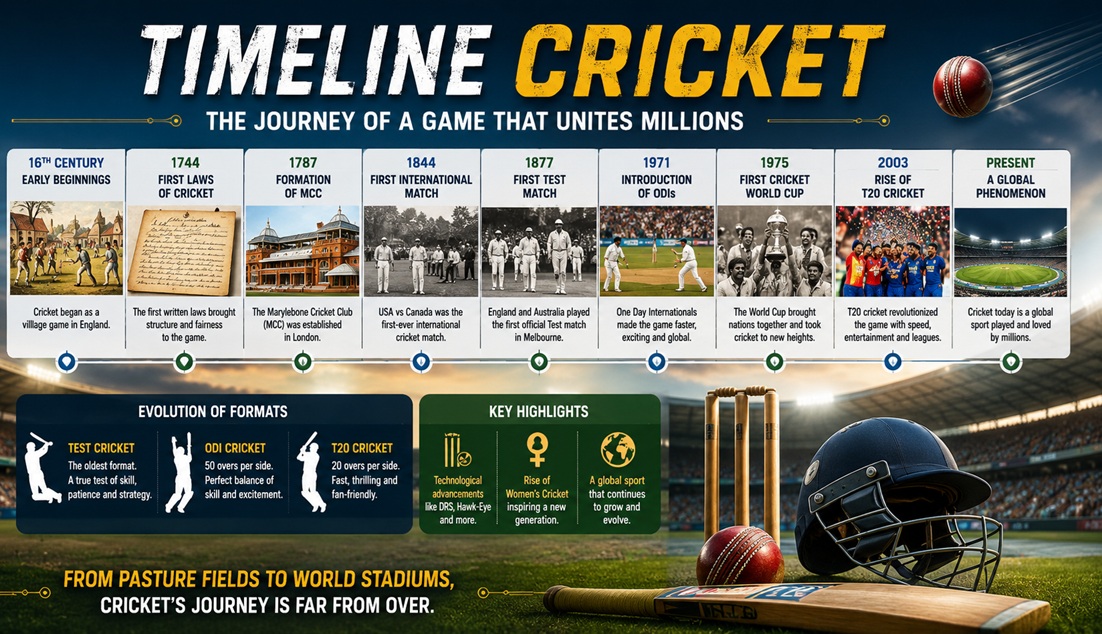
Timeline Cricket
Introduction
Timeline cricket represents the incredible journey of a sport that has evolved over centuries into a global phenomenon. From its humble beginnings in rural England to becoming a multi-format international sport, cricket has seen countless transformations. Understanding timeline cricket allows fans to connect with the roots of the game while appreciating its modern advancements.
This article explores the most important milestones that have shaped cricket’s history, highlighting how the sport adapted to changing times and audiences.
1. Early Beginnings in the 16th Century
The story of timeline cricket begins in the 1500s in England. It is believed that cricket started as a simple children’s game played in villages. Over time, adults began participating, and the game slowly gained popularity.
By the 17th century, cricket had become more organized, with local teams competing against each other. The first recorded match dates back to 1646, marking the beginning of cricket’s documented history.
2. 1744: First Laws of Cricket
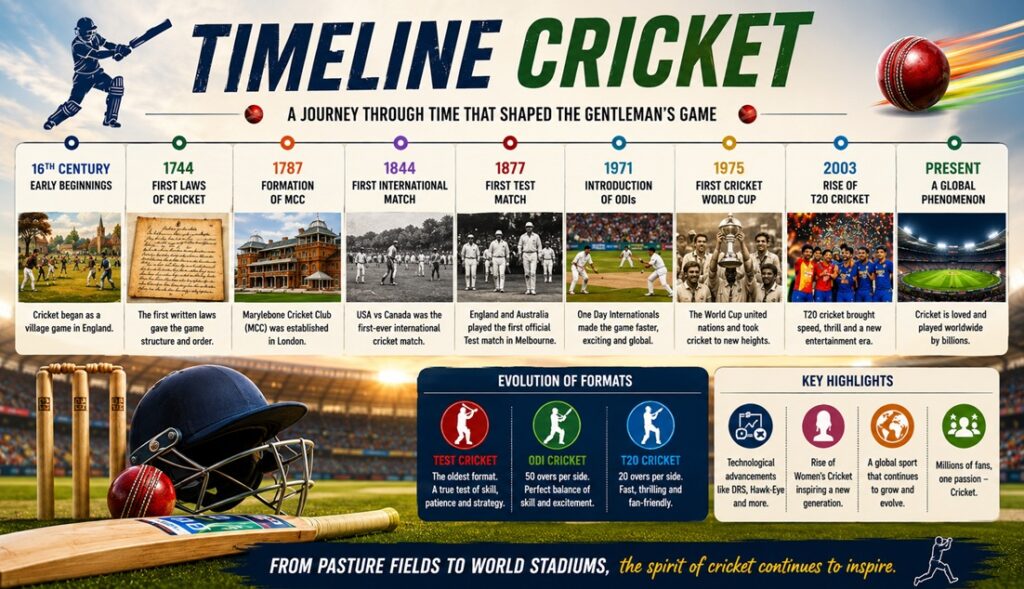
A major step in timeline cricket came in 1744 when the first official Laws of Cricket were written. Before this, the game had no standardized rules, leading to inconsistencies.
These laws introduced basic guidelines such as pitch dimensions, bat size, and dismissal methods. This milestone helped bring structure and fairness to the game.
3. 1787: Formation of MCC
The establishment of the Marylebone Cricket Club (MCC) in 1787 was a defining moment in timeline cricket. The MCC became the governing body responsible for maintaining and updating the laws of the game.
Even today, MCC plays a crucial role in preserving cricket’s traditions while adapting rules to modern needs.
4. 1844: First International Match
The first international cricket match was played in 1844 between the United States and Canada. Although not widely recognized at the time, it marked the beginning of international competition.
This event laid the foundation for future global tournaments and rivalries that define timeline cricket today.
5. 1877: First Test Match
One of the most significant milestones in timeline cricket occurred in 1877 when England and Australia played the first official Test match in Melbourne.
Test cricket became the longest and most traditional format of the game, emphasizing skill, patience, and strategy. It remains a prestigious format even in the modern era.
6. Early 20th Century Expansion
During the early 1900s, cricket expanded beyond its traditional boundaries. Countries like India, South Africa, and the West Indies joined international cricket, making the sport more diverse.
This period also saw the rise of legendary players who contributed to the growing popularity of timeline cricket across continents.
7. 1971: Introduction of One Day Internationals
A revolutionary change in timeline cricket came in 1971 with the introduction of One Day Internationals (ODIs). This format limited matches to a fixed number of overs, making games shorter and more exciting.
ODIs attracted larger audiences because they delivered results within a single day. This innovation played a major role in popularizing cricket globally.
8. 1975: First Cricket World Cup
The first Cricket World Cup was held in 1975 in England, marking a new era in timeline cricket. It brought together top international teams in a competitive tournament format.
The success of the World Cup turned cricket into a global spectacle and established a tradition that continues to captivate fans worldwide.
9. 2003: Rise of T20 Cricket
The introduction of Twenty20 (T20) cricket in 2003 transformed the timeline cricket landscape. Matches were reduced to just 20 overs per side, making the game faster and more entertaining.
T20 cricket appealed to younger audiences and casual viewers. Leagues like the IPL added glamour, financial growth, and worldwide attention to the sport.
10. Modern Era and Technological Advancements
In the modern era, timeline cricket has embraced technology to improve fairness and accuracy. Tools like the Decision Review System (DRS), Hawk-Eye, and UltraEdge assist umpires in making better decisions.
Cricket has also become more data-driven, with teams using analytics to enhance performance. These advancements have taken the sport to a new level of professionalism.
Growth of Women’s Cricket
An important development in timeline cricket is the rapid growth of women’s cricket. Over the years, women’s matches have gained recognition, with international tournaments attracting large audiences.
This progress has made cricket more inclusive and has inspired a new generation of players and fans.
Global Popularity Today
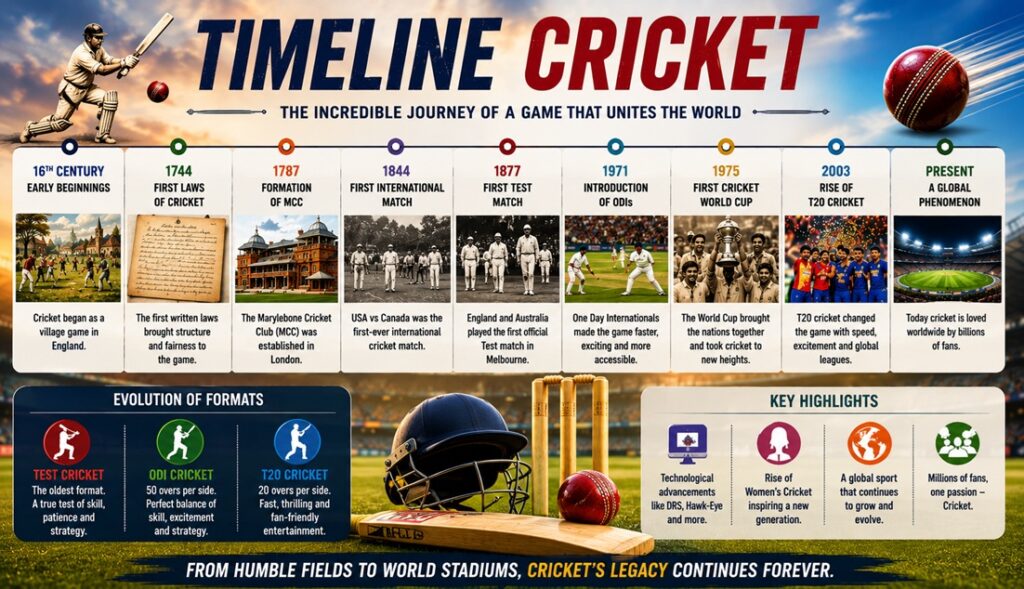
Today, timeline cricket reflects a truly global sport played and followed by millions. Countries like India, Australia, England, and Pakistan dominate international competitions, while emerging teams continue to rise.
The presence of multiple formats—Test, ODI, and T20—ensures that cricket caters to different audiences, making it one of the most versatile sports in the world.
Conclusion
The journey of timeline cricket is a story of continuous evolution. From a simple village game to an international sport with millions of fans, cricket has adapted to changing times while preserving its core essence.
Each milestone—from the first recorded match to modern T20 leagues—has played a crucial role in shaping the game. Understanding timeline cricket not only deepens appreciation for the sport but also highlights its rich history and exciting future.
As cricket continues to grow, new milestones will be added to its timeline, ensuring that the game remains dynamic, engaging, and loved across generations.
About the Author