History of Cricket Bat Timeline
History of Cricket Bat Timeline: 7 Powerful Stages That Transformed the Game
Introduction
The cricket bat is more than just a piece of sports equipment—it is a symbol of the game’s evolution, tradition, and innovation. From its humble beginnings as a simple wooden stick to today’s technologically advanced designs, the cricket bat has undergone remarkable transformations. Understanding the history of cricket bat timeline not only reveals how the game has changed but also highlights how players have adapted their techniques over time. Each stage in the bat’s evolution reflects shifts in rules, playing styles, and technological advancements.
Early Origins (16th–17th Century)
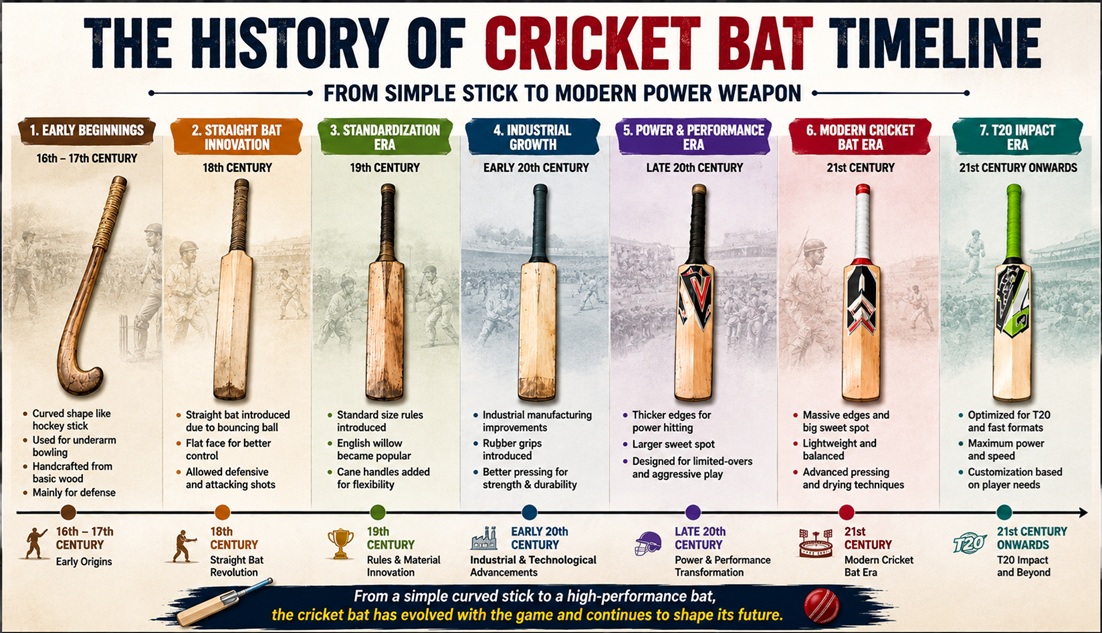
The earliest form of cricket dates back to the 16th century in England. During this period, the cricket bat looked very different from what we see today. It resembled a curved hockey stick, mainly because the ball was bowled underarm and rolled along the ground.
Players used bats that were:
- Curved in shape
- Made from basic wood
- Designed for defense rather than aggressive play
The primary goal was to stop the ball rather than hit it far. There were no standardized dimensions, and each bat was handcrafted. This phase represents the starting point in the history of cricket bat timeline, where functionality mattered more than performance.
The Straight Bat Revolution (18th Century)
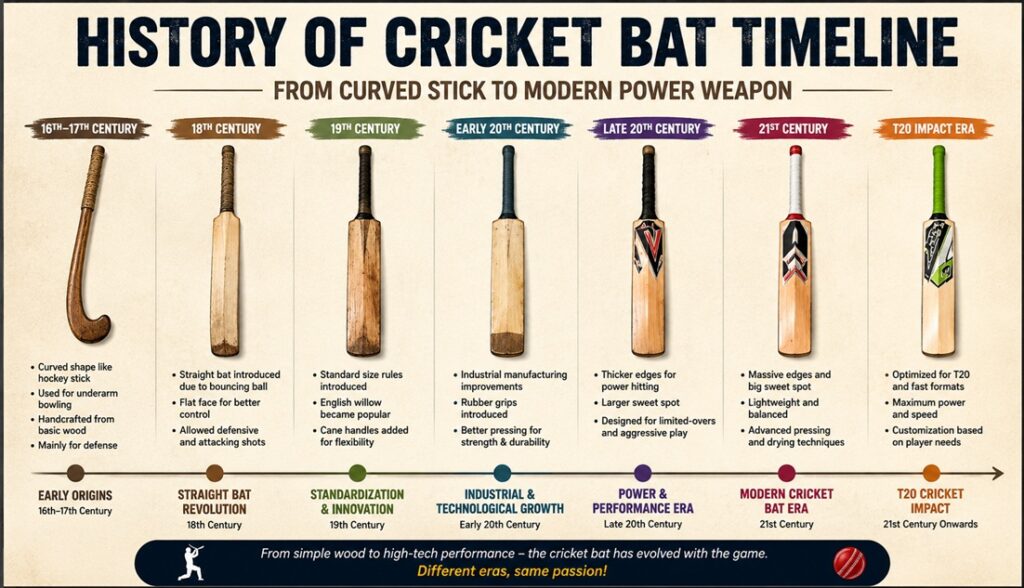
The 18th century marked a major turning point in cricket history. Bowlers began to pitch the ball instead of rolling it, introducing bounce into the game. This change forced batsmen to rethink their approach, leading to the invention of the straight bat.
Key developments included:
- Flat blade replacing curved design
- Improved control against bouncing deliveries
- Better shot-making capabilities
This transformation allowed batsmen to play more technical and defensive strokes, such as forward defense and drives. The straight bat quickly became the standard, forming the basis of modern cricket bat design.
Standardization and Material Innovation (19th Century)
The 19th century brought structure and consistency to cricket equipment. As the game became more organized, rules were introduced to standardize the size and shape of bats.
Major milestones:
- Maximum bat width set at 4.25 inches
- Introduction of English willow as the preferred material
- Cane handles added for flexibility and shock absorption
English willow became popular because it was lightweight yet strong, allowing players to generate power without losing control. The addition of cane handles improved comfort and reduced vibrations, making batting more efficient.
This era played a crucial role in refining the cricket bat and ensuring uniformity across the sport.
Industrial and Technological Growth (Early 20th Century)
The early 20th century saw significant improvements in manufacturing techniques. With the rise of industrialization, cricket bats were no longer entirely handmade but began to incorporate machine-assisted processes.
Important advancements:
- Better pressing techniques to strengthen the wood
- Introduction of rubber grips for improved handling
- Enhanced durability and consistency
These innovations made bats more reliable and accessible to players at all levels. The focus gradually shifted from just defense to balanced gameplay, allowing both defensive and attacking strokes.
Power and Performance Era (Late 20th Century)
The late 20th century witnessed a dramatic shift in cricket, especially with the introduction of limited-overs formats. Bats were redesigned to support more aggressive play.
Key features of this era:
- Thicker edges for power hitting
- Larger sweet spots
- Slightly heavier blades for stronger impact
Players began playing innovative shots like pulls, hooks, and lofted drives with greater confidence. The bat became a weapon for scoring runs quickly, especially in one-day matches.
This phase marked a transition toward performance-focused design in the history of cricket bat timeline.
Modern Cricket Bat Era (21st Century)
In the 21st century, cricket bats have reached an advanced level of engineering. With the popularity of T20 cricket, the demand for powerful and lightweight bats has increased significantly.
Modern bats feature:
- Massive edges for explosive shots
- Lightweight profiles for faster swing speed
- Advanced pressing and drying techniques
- Customization based on player preferences
Manufacturers now design bats tailored to individual playing styles. Whether a player prefers power hitting or precise stroke play, there is a bat designed specifically for their needs.
Impact of T20 Cricket on Bat Evolution
The rise of T20 cricket has had a huge influence on bat design. This fast-paced format requires players to score quickly, leading to innovations focused on maximizing power.
Changes driven by T20 cricket:
- Bigger sweet spots for consistent hitting
- Improved balance for quick shots
- Enhanced durability for high-impact play
Modern bats are now optimized for six-hitting, making matches more entertaining for fans. This evolution shows how the format of the game directly impacts equipment design.
Key Milestones in Cricket Bat Timeline
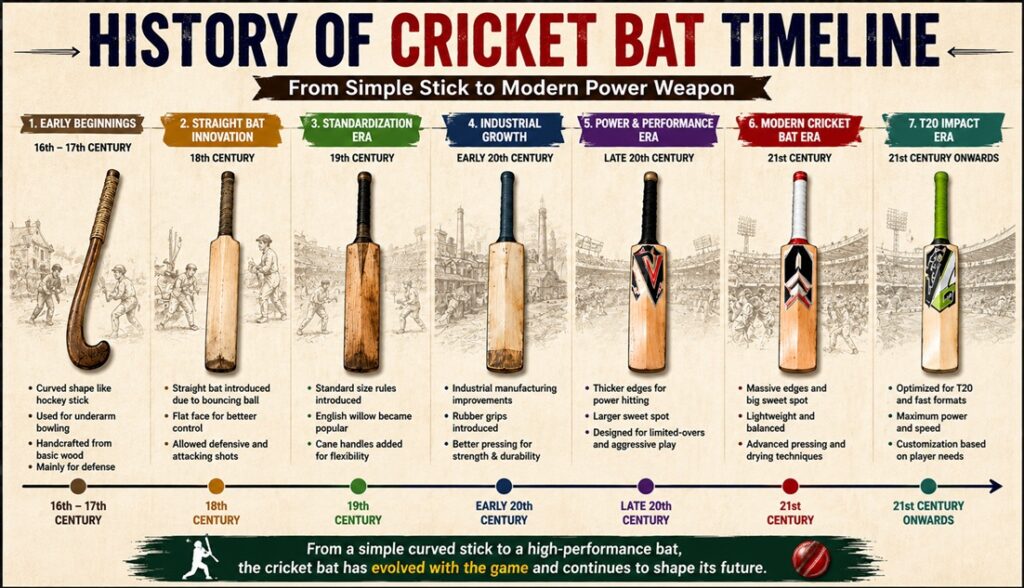
- 16th Century: Curved bats used for ground-level bowling
- 18th Century: Straight bat introduced due to bouncing deliveries
- 19th Century: Standard size rules and willow wood adoption
- Early 20th Century: Industrial manufacturing improvements
- Late 20th Century: Power-focused bat design emerges
- 21st Century: Advanced, lightweight, and customized bats
Conclusion
The history of cricket bat timeline is a story of continuous innovation and adaptation. From simple curved sticks to high-performance modern bats, each stage reflects the changing nature of cricket. As the game evolves, so does the equipment, ensuring players can perform at their best.
Today’s cricket bat is not just a tool—it is the result of centuries of craftsmanship, technology, and passion for the game. Looking ahead, future advancements may bring even more exciting changes, but the essence of the cricket bat will always remain rooted in its rich history.
Understanding this journey helps fans and players appreciate not just the game, but the evolution behind every powerful shot played on the field.
About the Author