Women’s Cricket World Cup History Timeline
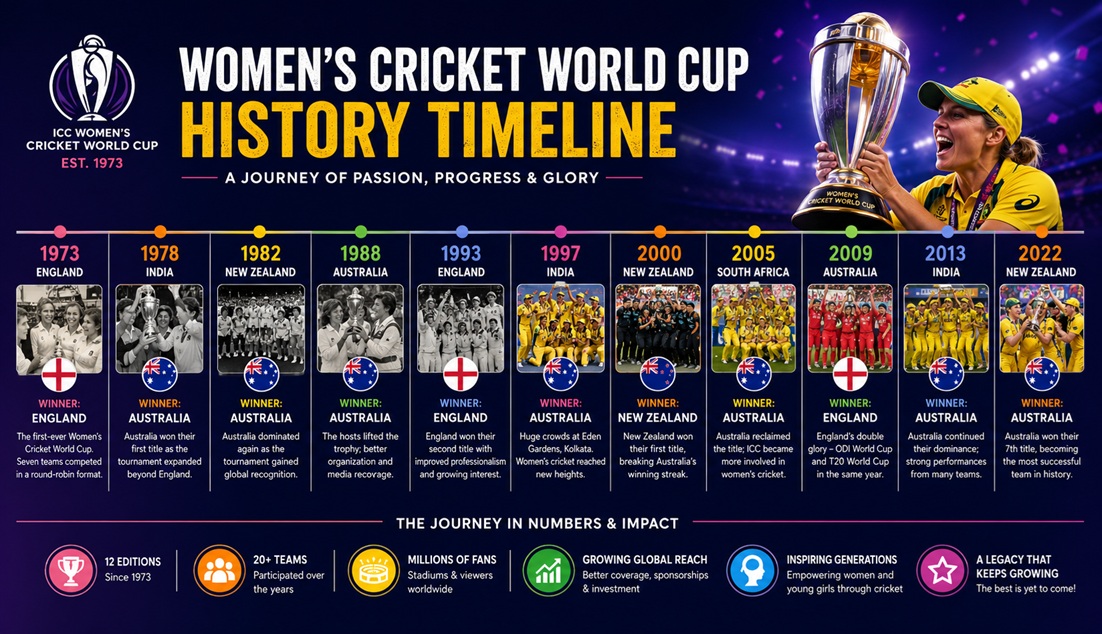
Women’s Cricket World Cup History Timeline: 12 Moments in a Complete Journey of Growth and Glory
The Women’s Cricket World Cup is one of the most important tournaments in the history of cricket. It represents not only competitive excellence but also the growth, recognition, and empowerment of women in sports. Over the decades, this tournament has evolved from a modest beginning into a globally celebrated event. Let’s explore the complete timeline of the Women’s Cricket World Cup and understand how it shaped modern women’s cricket.
1973 – The Beginning of a Historic Tournament
The first-ever Women’s Cricket World Cup was held in 1973 in England. Interestingly, it was conducted two years before the men’s Cricket World Cup. The tournament was organized largely due to the efforts of Rachael Heyhoe Flint and sponsored by Sir Jack Hayward.
England emerged as the first champions, defeating Australia. This edition featured seven teams, including an “International XI” and a “Young England” side. The matches were played in a round-robin format, and it laid the foundation for women’s international cricket competitions.
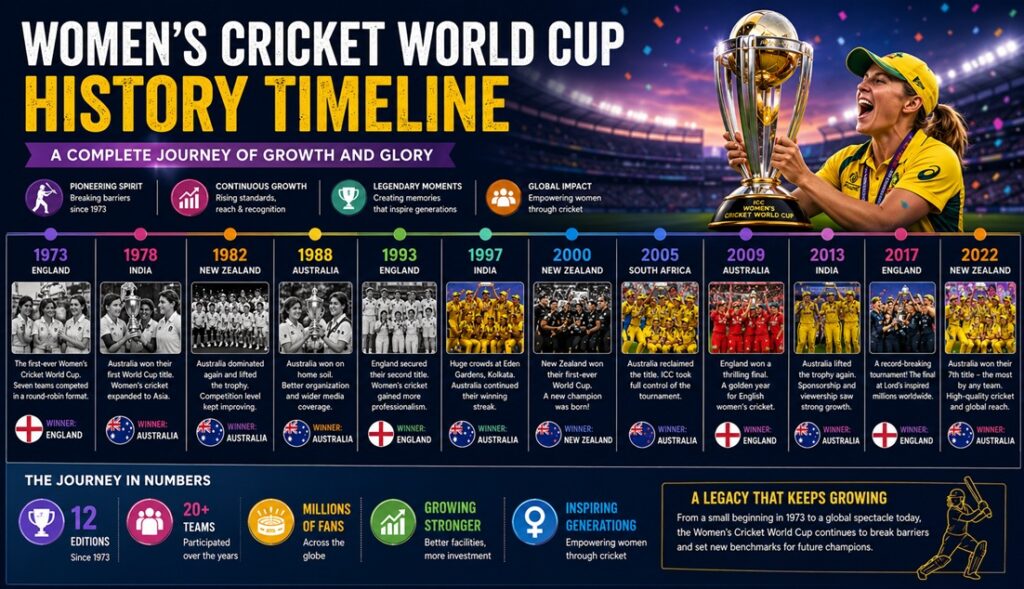
1978 – Australia Takes the Crown
The second edition took place in India in 1978. This was a significant step as it marked the expansion of the tournament beyond England. Australia dominated the competition and secured their first World Cup title.
However, the tournament faced challenges such as limited infrastructure and financial constraints. Despite this, it helped spread awareness about women’s cricket in Asia.
1982 – New Zealand Hosts, Australia Dominates Again
In 1982, New Zealand hosted the World Cup. Australia once again proved their strength and won the title. This tournament showcased improved organization and growing competitiveness among teams.
The participation of teams like India and England showed that women’s cricket was gaining global recognition.
1988 – Return to Australia
The 1988 World Cup was held in Australia, where the hosts claimed another title. By this time, the tournament structure had improved significantly, and the level of competition had increased.
This edition also saw better media coverage compared to previous tournaments, which helped in promoting the women’s game.
1993 – England Triumphs Again
England hosted the 1993 World Cup and secured their second title. This tournament is often remembered for its improved professionalism and increased spectator interest.
It also marked a period when governing bodies started paying more attention to women’s cricket development.
1997 – India Hosts a Landmark Event
The 1997 Women’s Cricket World Cup in India was a major milestone. The final match at Eden Gardens in Kolkata saw a massive crowd, one of the largest attendances for a women’s cricket match.
Australia won the tournament, continuing their dominance. This edition proved that women’s cricket could attract huge audiences and generate excitement similar to men’s matches.
2000 – New Zealand’s Historic Victory
The 2000 World Cup was held in New Zealand, and the host nation won their first title. This victory broke Australia’s winning streak and added a new chapter to the tournament’s history.
It showed that other teams were catching up and the competition was becoming more balanced.
2005 – Australia Reclaims Supremacy
South Africa hosted the 2005 World Cup, and Australia returned to the top by winning the title again. This tournament marked a new era with better broadcasting and global coverage.
The International Cricket Council (ICC) began playing a more active role in organizing women’s cricket events.
2009 – England’s Double Glory
The 2009 edition was held in Australia, and England emerged as champions. This was a remarkable year for England as they also won the Women’s T20 World Cup.
The tournament highlighted the growing professionalism and fitness standards in women’s cricket.
2013 – Australia Continues Dominance
India hosted the 2013 World Cup, and Australia once again proved their dominance by winning the title. The tournament featured strong performances from teams like England and West Indies.
This edition also saw better sponsorship and increased media attention, reflecting the growing popularity of the sport.
2017 – A Turning Point for Women’s Cricket
The 2017 Women’s Cricket World Cup in England is considered a game-changer. The final between England and India at Lord’s attracted millions of viewers worldwide.
England won a thrilling final, but the real victory was for women’s cricket itself. The tournament received massive media coverage, and players became global stars.
2022 – Australia’s Record-Breaking Win
The 2022 World Cup was held in New Zealand, and Australia delivered a dominant performance to win their seventh title. This made them the most successful team in the tournament’s history.
The competition showcased high-quality cricket, improved infrastructure, and increased global fan engagement.
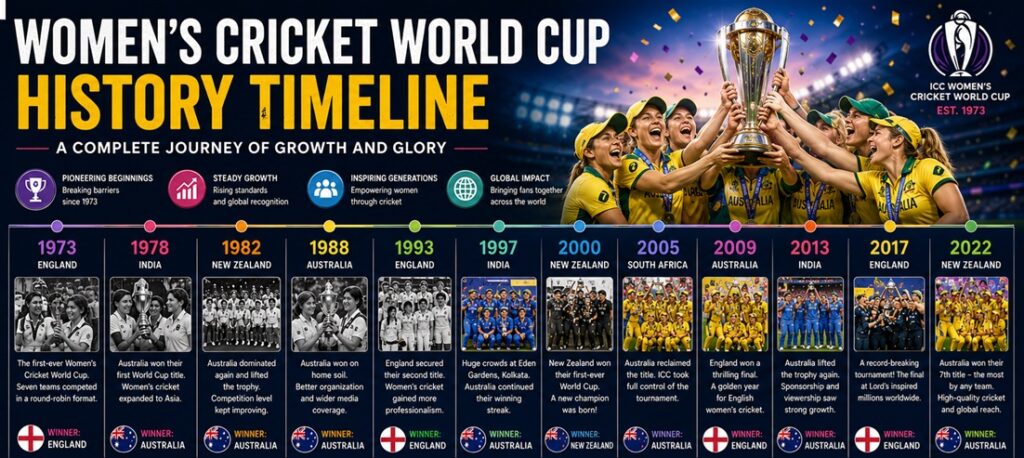
Key Milestones in the Timeline
- First tournament (1973): England wins the inaugural title
- Global expansion (1978 onwards): More countries participate
- Increased professionalism (1990s): Better organization and structure
- ICC involvement (2005 onwards): Improved management and promotion
- Mass popularity (2017): Record-breaking viewership
- Modern era (2022): High competitiveness and global recognition
Evolution of the Tournament Format
Over the years, the Women’s Cricket World Cup has evolved significantly. Early editions used simple round-robin formats, but modern tournaments include group stages, knockout rounds, and advanced qualification systems.
The introduction of technology, better pitches, and professional training has elevated the quality of the game.
Impact on Women’s Cricket
The Women’s Cricket World Cup has played a crucial role in promoting gender equality in sports. It has inspired young girls worldwide to take up cricket and pursue it as a career.
Players like Mithali Raj, Meg Lanning, and Charlotte Edwards have become role models, showcasing the potential of women in cricket.
Conclusion
The Women’s Cricket World Cup history timeline is a story of determination, growth, and success. From a small tournament in 1973 to a globally celebrated event, it has come a long way.
Today, it stands as a symbol of progress in sports, breaking barriers and creating opportunities for women worldwide. As the tournament continues to grow, its legacy will inspire future generations and further strengthen the foundation of women’s cricket.
This journey proves that with passion, support, and opportunity, women’s cricket can reach even greater heights in the years to come.
About the Author