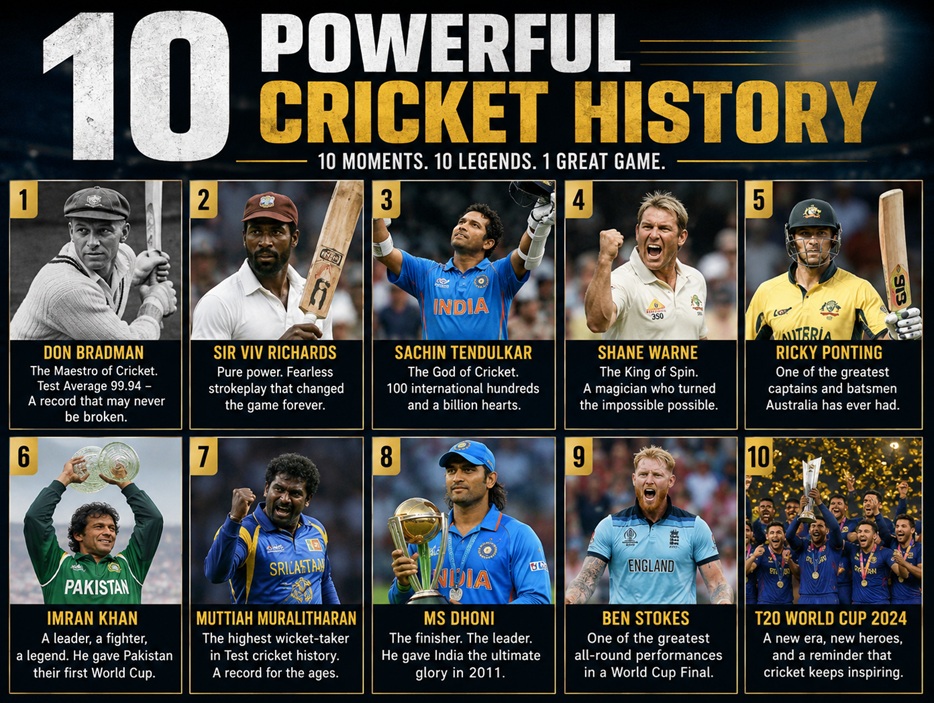
10 Powerful Cricket History
10 Powerful Cricket History Origins Development Timeline Milestones That Changed the Game Forever
Cricket is one of the world’s most popular sports, enjoyed by millions of fans across continents. The game has evolved from a simple rural pastime into a global sporting phenomenon. Understanding the cricket history origins development timeline helps us appreciate how the sport transformed over centuries into the modern game we know today.
The Origins of Cricket
The exact origin of cricket remains uncertain, but historians generally believe the game began in southeastern England during the medieval period. Evidence suggests that children in rural communities played an early version of cricket as far back as the 13th century.
The first documented reference to cricket appeared in 1598 when a court case mentioned a game called “creckett” being played in Surrey, England. During these early years, the sport was primarily a recreational activity played by local villagers and farm workers.
Cricket gradually gained popularity among adults, particularly in southern England. As participation increased, informal rules began to emerge, laying the foundation for the structured sport that would follow.
Cricket in the Seventeenth Century
The seventeenth century marked an important stage in cricket’s development. The game spread throughout England and became increasingly organized. Local matches attracted spectators, and gambling on cricket contests became common.
By the late 1600s, cricket had evolved beyond a simple village pastime. Wealthy landowners started sponsoring teams, helping improve the quality of competition. This period also saw the introduction of more formal playing methods and equipment.
The growing popularity of cricket during this era established the foundation for future expansion and professional competition.
The Eighteenth Century: Organized Cricket Emerges
The eighteenth century is often considered the beginning of modern cricket. During this period, cricket became England’s leading summer sport.
Several major developments occurred:
- Formation of organized cricket clubs.
- Increased spectator interest.
- Standardization of basic rules.
- Development of specialized cricket equipment.
In 1744, the first known written Laws of Cricket were established. These rules provided consistency and helped regulate matches across different regions.
The famous London-based Artillery Ground became a major venue for cricket matches, attracting large crowds and contributing to the sport’s growing reputation.
Establishment of Marylebone Cricket Club
A major milestone in the cricket history origins development timeline occurred in 1787 with the establishment of the Marylebone Cricket Club (MCC).
The MCC quickly became the guardian of cricket laws and standards. The club’s influence helped ensure uniformity across the sport and remains significant today.
The MCC introduced several important reforms that shaped modern cricket, including revisions to rules, playing conditions, and equipment standards.
Nineteenth Century: Global Expansion
The nineteenth century witnessed cricket’s rapid international expansion. As the British Empire grew, cricket spread to many regions around the world.
Countries that adopted cricket included:
- Australia
- India
- South Africa
- New Zealand
- West Indies
British soldiers, administrators, and settlers introduced the game to local populations. Over time, these regions developed their own cricket cultures and competitive structures.
One of the most important events occurred in 1877 when the first official Test match was played between Australia and England in Melbourne. This match marked the birth of international Test cricket.
The Birth of The Ashes
In 1882, Australia defeated England at The Oval in London. Following the defeat, a satirical newspaper published an obituary claiming English cricket had died and its “ashes” would be taken to Australia.
This event led to the creation of The Ashes, one of cricket’s most famous and historic rivalries. The Ashes remains a highlight of international cricket today.
Twentieth Century: Professionalization and Growth
The twentieth century transformed cricket into a truly global sport. International tours became more frequent, and cricket boards established stronger administrative systems.
Several nations achieved Test status, expanding elite competition worldwide. Advances in transportation and communication allowed international cricket to flourish.
Key developments included:
- Improved cricket equipment.
- Better stadium infrastructure.
- Expansion of international tournaments.
- Professional player contracts.
During this period, cricket became deeply embedded in the cultures of many countries, especially India, Australia, Pakistan, and the Caribbean nations.
The Arrival of Limited-Overs Cricket
A revolutionary change occurred in the 1960s and 1970s with the introduction of limited-overs cricket.
Traditional Test matches could last up to five days, but limited-overs formats offered shorter, more exciting contests. One-Day International (ODI) cricket quickly gained popularity among players and fans.
In 1975, the first Cricket World Cup was held in England. The tournament demonstrated cricket’s potential as a global spectator sport and attracted significant international attention.
The Twenty-First Century and T20 Revolution
The twenty-first century brought another major transformation through Twenty20 (T20) cricket.
Introduced in England in 2003, T20 cricket reduced matches to just 20 overs per side. The shorter format appealed to modern audiences seeking fast-paced entertainment.
The launch of the Indian Premier League in 2008 changed cricket forever. Combining world-class players, franchise teams, and massive broadcasting deals, the IPL became one of the world’s most valuable sporting leagues.
Many countries subsequently established their own T20 leagues, contributing to cricket’s commercial growth and global reach.
Cricket Today
Today, cricket is played professionally and recreationally across the globe. The sport includes multiple formats:
- Test Cricket
- One-Day Internationals (ODIs)
- Twenty20 Internationals (T20Is)
- Franchise T20 Leagues
Organizations such as the International Cricket Council (ICC) oversee international competitions and promote cricket’s continued development.
Major tournaments like the Cricket World Cup, T20 World Cup, and Champions Trophy attract millions of viewers worldwide.
Conclusion
The cricket history origins development timeline reveals a remarkable journey spanning more than seven centuries. From its humble beginnings in medieval English villages to its status as a global sport watched by billions, cricket has continuously evolved while preserving its traditions. Through innovation, international expansion, and new formats, cricket remains one of the most influential and beloved sports in the world, with a rich history that continues to inspire future generations.
About the Author