Australian Cricket History Timeline
Australian Cricket History Timeline: 10 Powerful Milestones You Must Know
Australian cricket has grown from a simple colonial pastime into one of the most powerful forces in international sport. Its journey reflects not only sporting success but also determination, innovation, and a deep cultural connection with the game. Over more than two centuries, Australia has built a legacy filled with unforgettable moments and legendary players.
Origins of Cricket in Australia
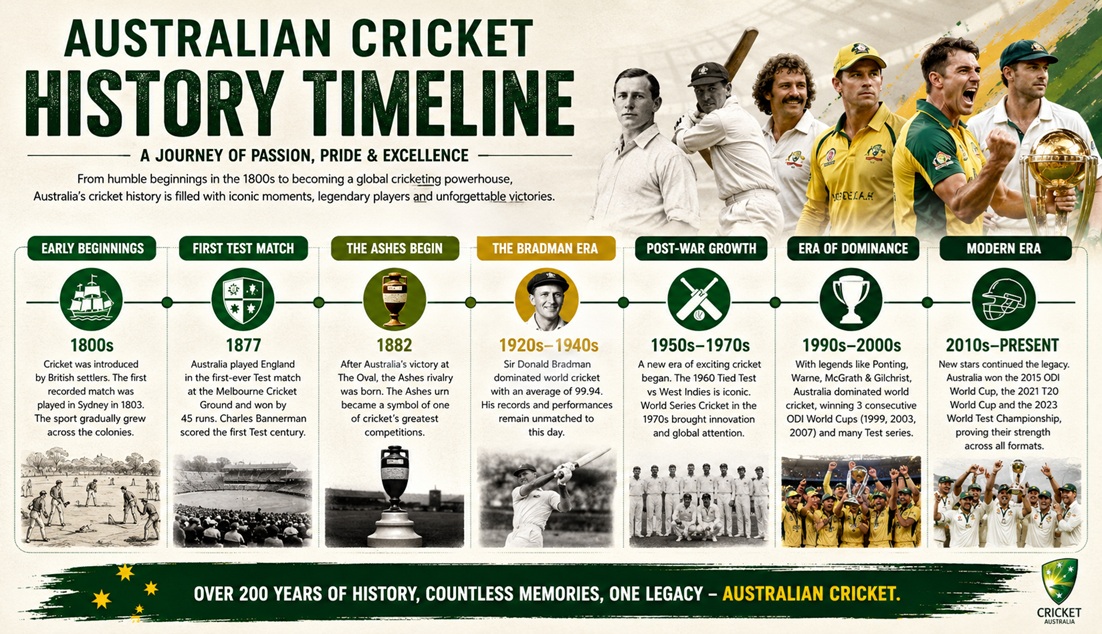
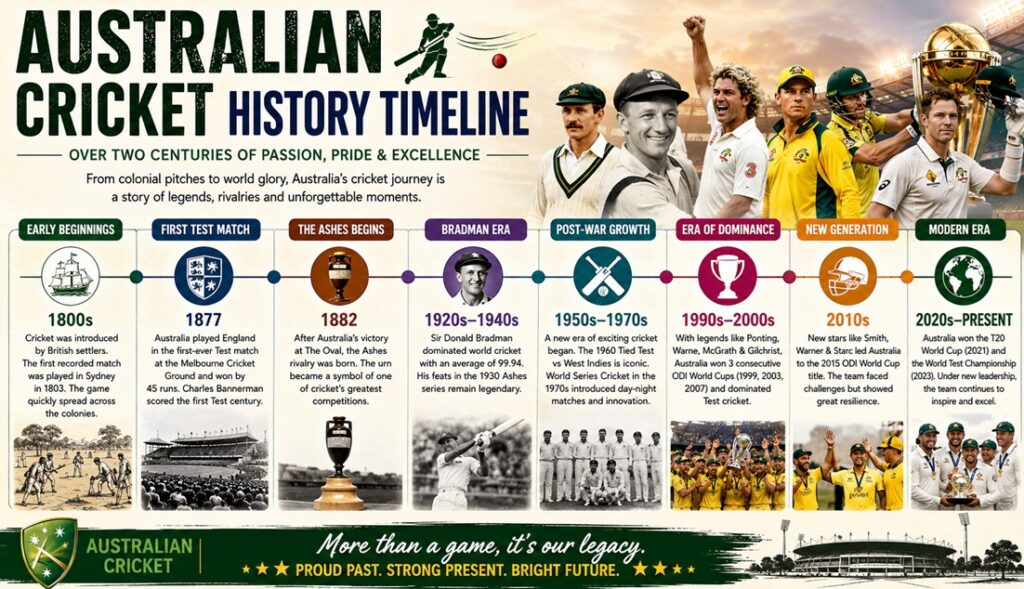
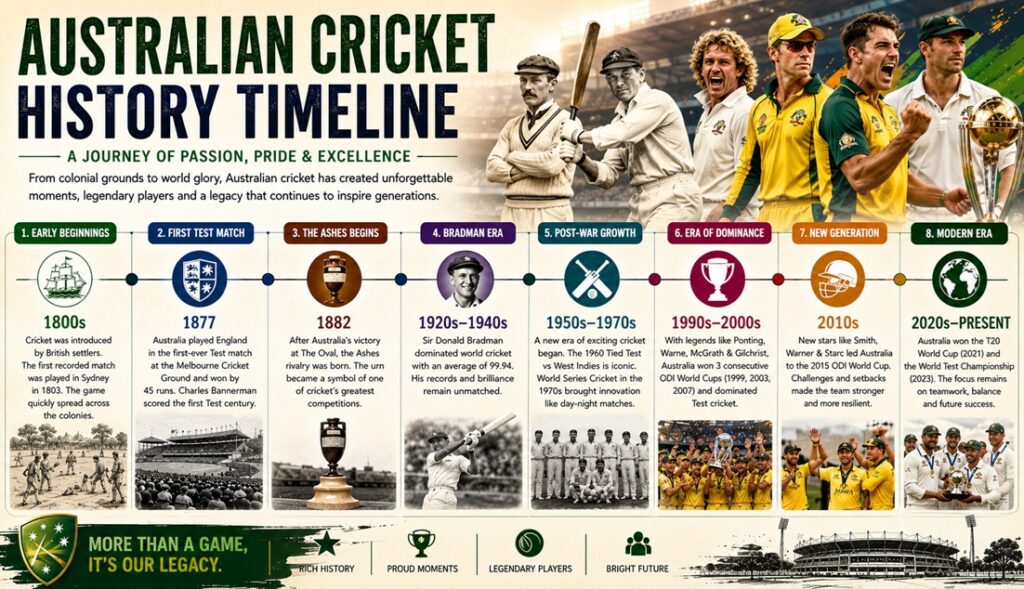
Cricket first arrived in Australia in the early 1800s with British settlers. What began as a leisure activity among soldiers and colonists gradually turned into a structured sport. By the mid-19th century, cricket was being played regularly across major regions such as New South Wales and Victoria.
The formation of early cricket clubs helped bring organization to the game. One of the most important developments was the establishment of the Melbourne Cricket Club in 1838. This institution played a major role in promoting cricket and setting standards that shaped the sport’s future in the country.
The Beginning of International Cricket
The year 1877 marked a historic turning point, not just for Australia but for the entire cricketing world. Australia hosted England in what became the first official Test match. Played at the Melbourne Cricket Ground, the match ended with an Australian victory, creating a strong foundation for international competition.
This event also introduced one of cricket’s earliest stars, Charles Bannerman, who scored a remarkable century in that match. His performance symbolized the beginning of Australia’s reputation as a competitive cricketing nation.
The Birth of a Legendary Rivalry
In 1882, cricket witnessed the birth of one of its most iconic rivalries—the Ashes. After Australia defeated England on English soil, a satirical newspaper article claimed that English cricket had “died,” and its ashes would be taken to Australia.
This moment gave rise to the Ashes series, which soon became one of the most celebrated competitions in sports. The rivalry added excitement, pride, and intensity to cricket, strengthening Australia’s global presence in the game.
The Bradman Era: Redefining Greatness
No discussion of Australian cricket history is complete without mentioning Sir Donald Bradman. Emerging in the late 1920s, Bradman changed the way cricket was played and understood. His extraordinary batting average of 99.94 remains unmatched and is often considered one of the greatest achievements in sports history.
Bradman’s performances during the 1930 Ashes series were extraordinary, as he consistently dominated the English bowlers. His discipline, focus, and skill set new standards for excellence. Even after his retirement, Bradman’s legacy continued to inspire generations of cricketers in Australia and beyond.
Post-War Era and Modern Developments
Following World War II, Australian cricket entered a new phase of rebuilding and growth. The team adopted a more attacking and entertaining style, which helped revive interest in the sport. Leadership during this time emphasized both competitiveness and sportsmanship.
One unforgettable highlight from this era was the tied Test match against the West Indies in 1960. It was the first tied Test in cricket history and demonstrated the unpredictable and thrilling nature of the game.
The 1970s brought another wave of transformation with the introduction of World Series Cricket. This initiative introduced major innovations such as colored uniforms, day-night matches, and improved broadcast coverage. These changes modernized cricket and made it more appealing to a wider audience.
Era of Dominance and Global Success
The late 20th century marked a golden period for Australian cricket. With a strong lineup of skilled and determined players, the team achieved remarkable success across all formats. This era was defined by consistency, confidence, and an aggressive approach to the game.
Australia’s dominance was particularly evident in global tournaments. Winning multiple World Cups in a short span showcased their ability to perform under pressure. The team also maintained a strong position in Test cricket, often leading rankings and setting new records.
This period not only brought victories but also established Australia as a benchmark for excellence in international cricket.
Transition and Resilience
As legendary players retired, Australian cricket entered a phase of transition. New players had the challenge of maintaining the high standards set by their predecessors. While there were moments of inconsistency, the team continued to compete at the highest level.
During this time, Australia faced both on-field and off-field challenges. However, these experiences contributed to rebuilding the team’s character and strengthening its approach to the game. The ability to adapt and recover became a defining trait of Australian cricket.
The Modern Era
In recent years, Australian cricket has successfully balanced experience with fresh talent. The team has continued to achieve success in major tournaments, proving its strength across different formats of the game.
Modern cricket in Australia focuses on fitness, strategy, and adaptability. Players are now more versatile, capable of performing in test matches, one-day internationals, and T20 formats. This flexibility has allowed Australia to remain competitive in a rapidly evolving cricketing landscape.
The leadership in the current era emphasizes teamwork, discipline, and long-term development. As a result, Australia continues to produce talented cricketers who carry forward the nation’s proud legacy.
Conclusion
The timeline of Australian cricket is a story of growth, innovation, and enduring excellence. From its early days as a colonial pastime to its rise as a global powerhouse, the journey reflects dedication and passion for the sport.
Each era has contributed something unique—whether it is the pioneering spirit of the early years, the brilliance of Bradman, or the dominance of modern teams. Together, these moments have shaped Australian cricket into what it is today.
As the game continues to evolve, Australia remains a central figure in world cricket, inspiring fans and players alike with its rich history and commitment to excellence.
About the Author