Key Milestones in Cricket History Timeline
15 Incredible Key Milestones in Cricket History Timeline That Changed the Game Forever
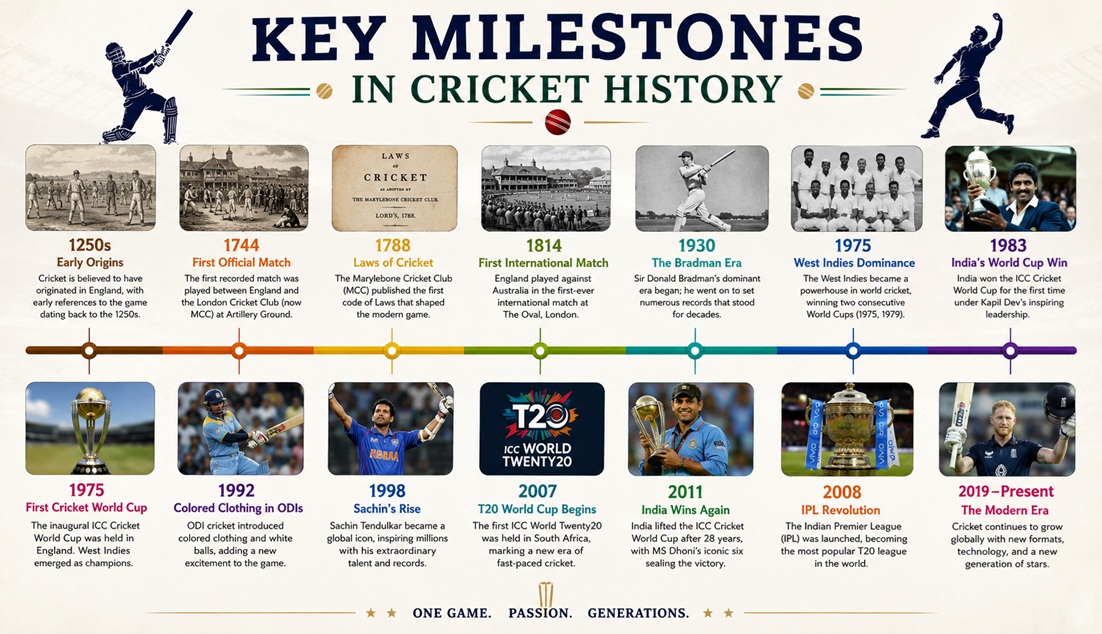
Cricket is one of the world’s most beloved sports, captivating millions of fans across continents. From its humble beginnings in rural England to becoming a global phenomenon, cricket has undergone remarkable transformations over the centuries. Understanding the key milestones in cricket history timeline helps us appreciate how the game evolved into the thrilling sport we know today.
The Origins of Cricket (16th Century)
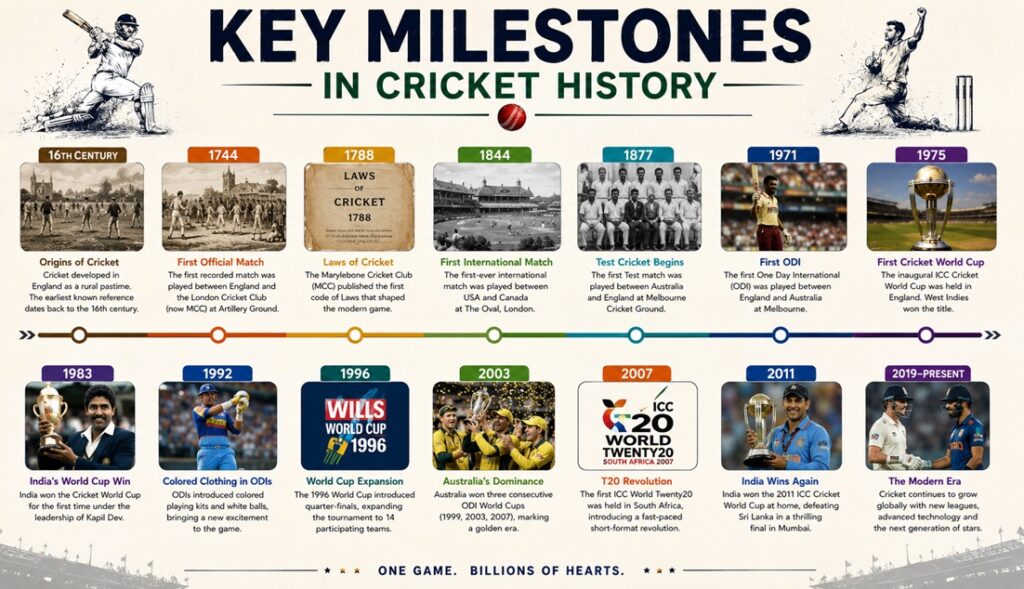
The earliest known references to cricket date back to the late 1500s in England. Historians believe the game originated among children in southeastern England before gradually becoming popular among adults. During this period, cricket was played informally in villages and open fields, with simple equipment and basic rules.
By the early 17th century, cricket had gained enough popularity to be recognized as an organized recreational activity. Wealthy landowners and noblemen began sponsoring matches, laying the foundation for the sport’s future development.
The First Recorded Cricket Match (1646)
One of the most significant events in cricket history occurred in 1646 when the first recorded cricket match took place in Kent, England. Although details of the game remain limited, this event marked the beginning of documented cricket competitions.
The recording of matches helped establish cricket as a legitimate sport rather than merely a local pastime. Over time, written records became crucial for preserving the game’s history and tracking its evolution.
Establishment of Formal Rules (1744)
A major milestone in cricket history timeline came in 1744 with the introduction of the first known written Laws of Cricket. These rules standardized various aspects of the game, including pitch dimensions, player conduct, and scoring methods.
The codification of rules reduced confusion and allowed teams from different regions to compete under the same regulations. This development played a critical role in cricket’s expansion throughout England and beyond.
Formation of Marylebone Cricket Club (1787)
The formation of the Marylebone Cricket Club (MCC) in 1787 transformed cricket governance forever. Based at Lord’s Cricket Ground in London, the MCC became the custodian of the Laws of Cricket.
For more than two centuries, the MCC has maintained and updated cricket’s regulations. Its influence helped ensure consistency and fairness as the sport spread internationally.
The First International Cricket Match (1844)
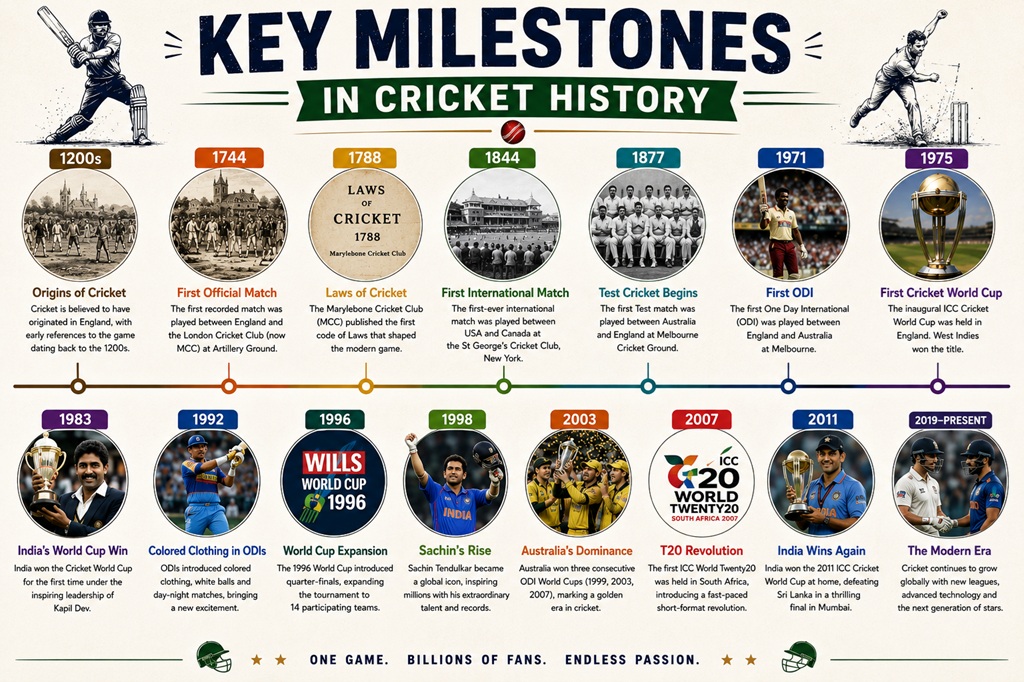
Cricket crossed national boundaries in 1844 when the United States and Canada played the first officially recognized international cricket match. Held in New York, this historic encounter demonstrated the sport’s growing popularity outside England.
Although cricket eventually declined in the United States, this match remains a landmark achievement in the development of international competition.
The Birth of Test Cricket (1877)
Perhaps the most important milestone in cricket history timeline occurred in 1877 when Australia and England played the first-ever Test match at the Melbourne Cricket Ground.
Test cricket introduced a higher level of competition and established the foundation for international rivalries. The five-day format emphasized skill, endurance, and strategy, making it the ultimate test of a player’s abilities.
The Ashes Rivalry Begins (1882)
The Ashes, one of the most famous rivalries in sports history, began in 1882 after Australia defeated England at The Oval. A satirical newspaper obituary declared that English cricket had died and its “ashes” would be taken to Australia.
This humorous remark inspired a competition that continues to captivate cricket fans worldwide. The Ashes remains a symbol of cricket’s rich traditions and fierce competitive spirit.
Formation of the Imperial Cricket Conference (1909)
In 1909, representatives from England, Australia, and South Africa established the Imperial Cricket Conference, which later became the International Cricket Council (ICC).
This governing body helped coordinate international cricket, establish playing standards, and organize global competitions. Today, the ICC oversees cricket’s growth in more than 100 countries.
Introduction of One-Day Cricket (1963)
The launch of limited-overs cricket in England during 1963 revolutionized the sport. One-Day Internationals (ODIs) offered a faster-paced alternative to traditional Test matches, making cricket more accessible to spectators.
The shorter format attracted larger audiences and television broadcasters, significantly increasing cricket’s commercial appeal and global reach.
First Cricket World Cup (1975)
A defining moment in cricket history timeline arrived in 1975 with the inaugural Cricket World Cup in England. The tournament brought together leading cricket nations to compete for a global championship.
The success of the World Cup elevated cricket’s international profile and established a prestigious event that continues to unite fans from around the world.
Introduction of T20 Cricket (2003)
Twenty20 cricket emerged in England in 2003 as a bold innovation designed to attract younger audiences. Matches lasted approximately three hours, providing fast-paced entertainment and exciting gameplay.
The format’s popularity exploded globally, introducing cricket to new markets and expanding its fan base dramatically.
Launch of the Indian Premier League (2008)
The creation of the Indian Premier League (IPL) in 2008 marked a new era for professional cricket. Combining elite talent, franchise ownership, and entertainment, the IPL transformed cricket into a major commercial enterprise.
The league attracted top players from around the world and inspired similar tournaments in other countries. Its success significantly increased player earnings and global viewership.
Adoption of Technology in Cricket
Modern cricket has embraced technological innovations to improve accuracy and fairness. The introduction of the Decision Review System (DRS), Hawk-Eye ball tracking, UltraEdge, and advanced analytics has enhanced umpiring decisions and player performance analysis.
Technology continues to shape the future of cricket, making the game more transparent and engaging for fans.
Cricket’s Global Expansion
Over recent decades, cricket has expanded beyond its traditional strongholds. Nations such as Afghanistan, Ireland, and Nepal have emerged as competitive forces on the international stage.
Women’s cricket has also experienced tremendous growth, with major tournaments attracting record audiences and increased investment. This expansion highlights cricket’s evolving role as a truly global sport.
Conclusion
The key milestones in cricket history timeline showcase a fascinating journey spanning more than four centuries. From village games in England to packed stadiums and global television audiences, cricket has continuously evolved while preserving its unique traditions.
Each milestone—from the creation of formal rules and the birth of Test cricket to the rise of T20 leagues and modern technology—has contributed to shaping the sport’s identity. As cricket continues to innovate and reach new audiences, its rich history remains a source of inspiration for players and fans alike.
About the Author