Cricket Bat Evolution
Cricket Bat Evolution Timeline: 12 Incredible Innovations That Changed Cricket Forever
Cricket is one of the worldâs oldest and most beloved sports, and the cricket bat has played a central role in its development. Over the centuries, the cricket bat has undergone remarkable changes in shape, size, weight, and materials. These improvements have not only enhanced player performance but also transformed the way the game is played.
The Origins of Cricket Bats (1600s)
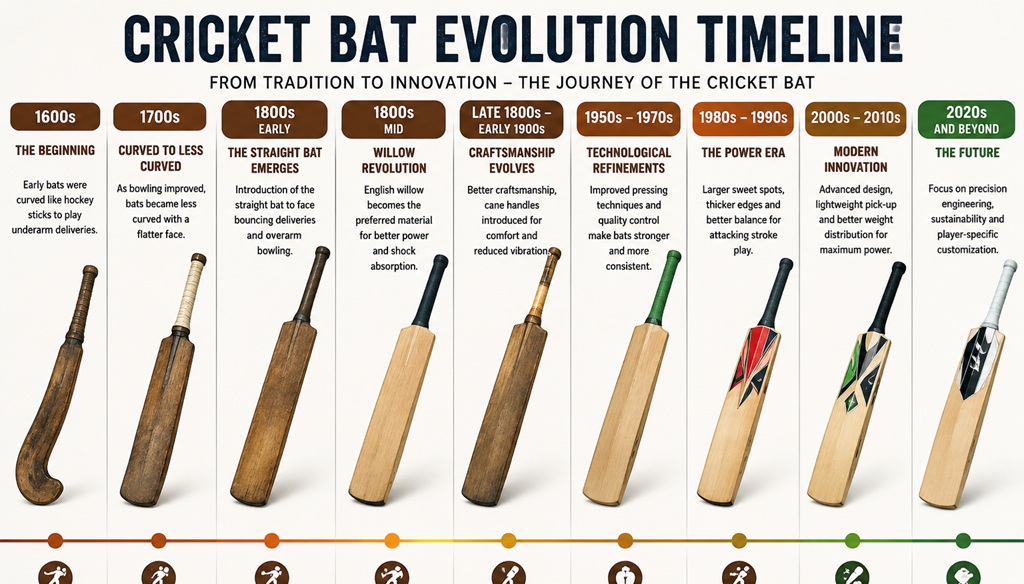
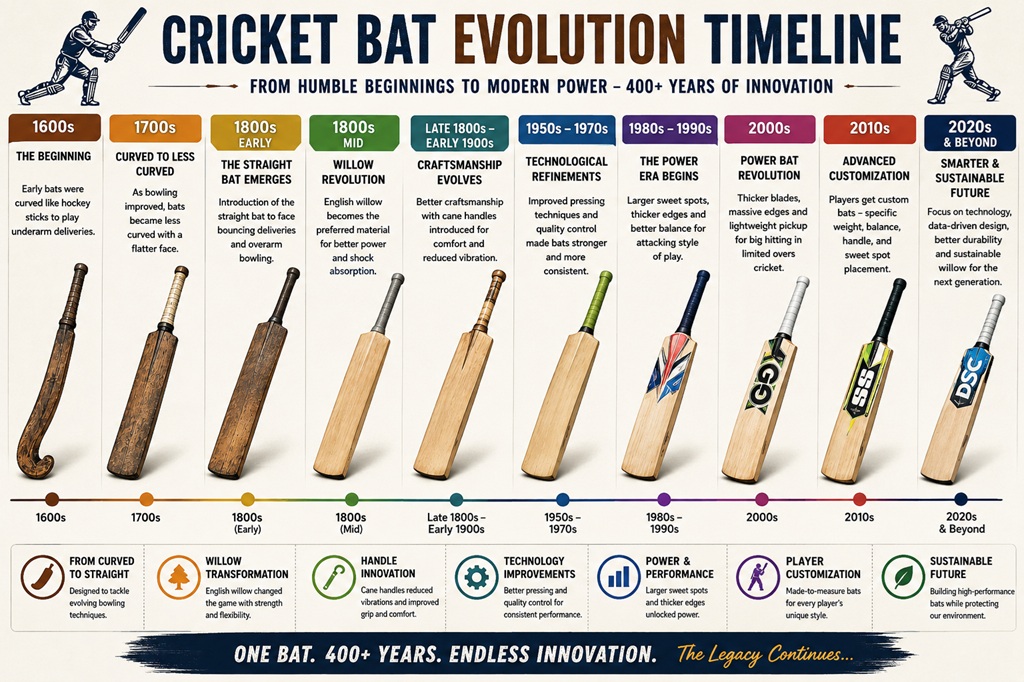
The earliest cricket bats appeared during the 17th century when cricket was still developing in England. These bats looked very different from modern designs. They resembled hockey sticks with long handles and curved blades.
The curved shape was necessary because bowlers delivered the ball underarm, rolling it along the ground toward the batsman. A curved bat made it easier to hit these low deliveries.
Key Features
Curved blade
Heavy wooden construction
Short handle
Designed for underarm bowling
These primitive bats marked the beginning of cricket equipment innovation.
1700s: The First Major Changes
As cricket became more organized, bowling styles started evolving. Bowlers began pitching the ball instead of rolling it, forcing batsmen to adapt.
During the mid-1700s, bat makers gradually reduced the curve and introduced flatter surfaces. This allowed players to play defensive shots and drive the ball more effectively.
Significant Development
In 1771, a batsman reportedly used a bat wider than the wicket to prevent being bowled. This incident led to the creation of regulations regarding bat dimensions.
New Rules Introduced
Maximum bat width set at 4.25 inches
Standardization efforts began
This was one of the earliest examples of cricket equipment regulation.
Late 1700s to Early 1800s: Rise of the Straight Bat
The introduction of overarm and roundarm bowling changed cricket dramatically. Batsmen now faced bouncing deliveries instead of balls rolling on the ground.
To handle these challenges, bat makers introduced the straight bat.
Features of Straight Bats
Flat front face
Longer blade
Better balance
Improved defensive capabilities
The straight bat became the foundation of modern cricket batting techniques.
Mid-1800s: Willow Becomes the Preferred Material
One of the most important moments in the cricket bat evolution timeline was the adoption of willow wood.
Bat makers discovered that willow provided an ideal combination of:
Strength
Flexibility
Shock absorption
English willow quickly became the gold standard for bat manufacturing.
Why Willow?
Willow fibers compress and recover effectively, allowing the bat to absorb impact while generating power.
This innovation significantly improved batting performance.
Late 1800s: Standardized Manufacturing
As cricket grew internationally, bat manufacturing became more professional.
Manufacturers introduced:
Consistent sizing
Better handle construction
Improved blade shaping
The cane handle was also developed during this period.
Benefits of Cane Handles
Reduced vibration
Better grip
Increased comfort
These improvements made batting safer and more efficient.
Early 1900s: The Golden Age of Bat Craftsmanship
The early twentieth century saw the emergence of skilled bat makers who focused on precision craftsmanship.
Bats during this era featured:
Carefully selected willow
Handcrafted designs
Enhanced balance
Players relied heavily on timing rather than brute power, so bat makers prioritized control and feel.
Famous Characteristics
Slim profiles
Lightweight construction
Traditional blade shapes
Many bats from this period are now considered collector’s items.
1950sâ1970s: Technological Refinements
Following World War II, cricket equipment manufacturing entered a new phase.
Advancements included:
Improved pressing techniques
Better quality control
Stronger handle designs
Manufacturers learned how to compress willow effectively without damaging its natural performance characteristics.
Impact on the Game
Players gained:
Greater durability
Enhanced stroke play
More reliable equipment
Cricket bats became increasingly consistent in quality.
1980s: The Era of Powerful Batting
The 1980s marked a major turning point in cricket.
Limited-overs cricket became popular, encouraging aggressive batting styles. Manufacturers responded by creating bats with larger sweet spots.
New Innovations
Thicker edges
Wider sweet spots
Improved weight distribution
These bats allowed players to hit boundaries more frequently.
Influence on Modern Cricket
The focus shifted from defensive play to attacking stroke-making.
This period laid the foundation for today’s power-hitting era.
1990s: Scientific Bat Design
During the 1990s, bat manufacturing embraced scientific methods.
Manufacturers began analyzing:
Wood density
Weight balance
Performance characteristics
Computer-assisted design helped optimize bat shapes.
Key Developments
Better weight-to-power ratios
Enhanced sweet spot positioning
Custom bat profiles
Professional players increasingly requested personalized bat specifications.
2000s: The Power Bat Revolution
The arrival of T20 cricket accelerated innovation.
Manufacturers introduced:
Massive edges
Thick spines
Lightweight pickups
Although bats became larger, they remained within official size regulations.
Popular Features
Explosive power
Bigger hitting zones
Enhanced performance for aggressive batting
Many cricket experts believe this era produced the most significant bat evolution since the adoption of willow.
2010s: Advanced Manufacturing Techniques
Modern manufacturing techniques transformed cricket bat production.
Companies began using:
Precision pressing machines
Moisture monitoring systems
Detailed quality inspections
Players benefited from bats offering superior consistency and performance.
Professional Customization
Cricketers could now select:
Specific weights
Handle types
Edge profiles
Sweet spot locations
Customization became a major trend in professional cricket.
2020s: Innovation and Sustainability
The latest chapter in the cricket bat evolution timeline focuses on performance and sustainability.
Manufacturers are now exploring:
Eco-friendly production methods
Sustainable willow cultivation
Enhanced durability technologies
Modern bats combine traditional craftsmanship with cutting-edge engineering.
Current Trends
Lightweight power bats
Advanced grip technologies
Improved shock absorption
Sustainable manufacturing practices
Today’s cricket bats represent centuries of continuous innovation.
Key Milestones in Cricket Bat Evolution Timeline
PeriodMajor Development1600sCurved hockey-stick-style bats1700sIntroduction of bat width regulationsEarly 1800sRise of the straight batMid-1800sAdoption of willow woodLate 1800sStandardized manufacturingEarly 1900sEnhanced craftsmanship1950sâ1970sImproved pressing techniques1980sLarger sweet spots1990sScientific bat design2000sPower bat revolution2010sAdvanced customization2020sSustainable innovation
Conclusion
The Cricket Bat Evolution Timeline reflects the fascinating journey of cricket itself. From simple curved wooden bats used in the 1600s to today’s technologically advanced power bats, every era has contributed to improving performance and enhancing the game. As cricket continues to evolve, manufacturers will undoubtedly develop even more innovative designs, ensuring that the cricket bat remains one of the sport’s most iconic and essential pieces of equipment.
The future of cricket bat technology promises an exciting blend of tradition, performance, and sustainability, continuing a legacy that spans more than four centuries.
About the Author